
Is Douglas Fir Rot Resistant? What The Wood Handbook Actually Says
What You’ll Learn in This Blog
- How the USDA Wood Handbook ranks Douglas Fir for natural decay resistance
- Why Douglas Fir heartwood resists decay better than sapwood
- How moisture and outdoor exposure affect Douglas Fir’s durability
- How Douglas Fir compares with cedar, redwood, and pressure-treated pine
- When Douglas Fir needs a finish or preservative treatment for outdoor use
Douglas Fir heartwood is rot-resistant, ranking in the third of four decay-resistance tiers set by the USDA Wood Handbook — “moderately resistant,” one tier below cedar, on par with young-growth redwood, and two tiers below the Handbook’s top-tier species, like black locust and old-growth redwood.
That single word, “moderately,” explains almost every conflicting thing you’ve read about this wood: it decays slower than pine, it’s not maintenance-free like cedar, and where you build with it matters as much as what you build.
The confusion around Douglas Fir usually comes from people skipping the actual source.
Everyone quotes the Wood Handbook secondhand, but almost nobody opens Chapter 14 and reads Table 14-1. Once you do, the picture is a lot clearer — and a lot more useful for deciding whether Douglas Fir belongs in your pergola, pavilion, or outdoor structure.
A few facts up front:
- Douglas Fir heartwood sits in the “moderately resistant” tier of the Wood Handbook’s four-tier decay classification — the same tier as western larch and black cherry.
- Only heartwood carries that resistance. Sapwood, regardless of species, is not decay-resistant.
- Decay requires sustained moisture content above roughly 20 to 30 percent. Keep Douglas Fir dry, and the decay question is mostly moot.
- A 2022 peer-reviewed study found the mechanism behind Douglas Fir’s resistance is partly chemical (extractives like taxifolin) and partly physical (how well the wood sheds water).
What The Wood Handbook Actually Says About Douglas Fir’s Decay Resistance
The Wood Handbook doesn’t rank wood species on a single durability scale. It groups them into four tiers based on how long untreated heartwood typically holds up against decay fungi, and Douglas Fir lands squarely in the third tier — not the bottom, not the top.
The Four-Tier Decay Resistance System, Explained
Chapter 14 of the Wood Handbook, “Biodeterioration of Wood,” sorts domestic species into very resistant, resistant, moderately resistant, and slightly-to-nonresistant categories, based on average heartwood performance.
The table below simplifies it:
|
Very resistant |
Resistant |
Moderately resistant |
Slightly / nonresistant |
|---|---|---|---|
|
Black locust |
Cedars (all) |
Douglas Fir |
True firs, hemlocks |
|
Osage-orange |
Baldcypress, old growth |
Redwood, young growth |
Spruces, Maples |
|
Mulberry, red |
Catalpa |
Western larch, black cherry |
Cottonwood, willows |
|
Yew, Pacific |
Redwood, old growth |
Honey locust |
Ashes, aspens |
Source: USDA Forest Products Laboratory, Wood Handbook, Chapter 14, Table 14-1, “Grouping of domestic woods according to heartwood decay resistance.”
Where Douglas Fir Sits — And Why That’s Not The Bottom Tier
Landing in “moderately resistant” puts Douglas Fir ahead of the framing lumber most people compare it to.
True firs, hemlocks, spruces, and the pine species most commonly sold as construction lumber today fall into the bottom tier.
Douglas Fir sits above all of them without any chemical treatment.
It doesn’t outperform cedar or the handful of naturally durable species at the top of the list — but the redwood comparison deserves a caveat most pergola guides skip: that “top of the list” spot belongs to old-growth redwood specifically.
Young-growth redwood, which is what’s actually sold in most lumberyards today, lands in the exact same moderately resistant tier as Douglas Fir.
That’s the specific answer the AI Overview compresses into “moderately durable” — and it’s the detail every Douglas Fir-vs-redwood comparison on the internet should be starting from.

Why Only The Heartwood Resists Decay
The Wood Handbook’s decay ratings describe heartwood specifically. That distinction changes what you should actually be asking a lumber supplier.
Heartwood Vs. Sapwood — The Distinction That Changes What You Should Ask For
Heartwood is the older, denser wood at the center of the log.
Sapwood is the younger, paler wood just under the bark, and it carries almost none of the natural decay resistance that gives Douglas Fir its rating — regardless of species.
A board cut mostly from sapwood behaves like a nonresistant wood no matter what the species label says.
That’s also why the Handbook’s rating only applies when you’re actually getting heartwood: specifying or confirming heartwood lumber is the one thing in this discussion you have direct control over as a buyer.
The Moisture Threshold That Actually Causes Rot
Decay fungi need sustained moisture content above roughly 20 to 30 percent, combined with favorable temperatures, to establish and spread.
Below that threshold, wood decay essentially stops regardless of species.
That’s the real variable behind most “does Douglas Fir rot” questions: it’s less about the wood and more about how long it stays wet
The Science Behind Douglas Fir’s Rot Resistance
The Wood Handbook tells you where Douglas Fir ranks.
A 2022 peer-reviewed study explains why — and it’s more interesting than most consumer wood guides let on.
What A 2022 Study Found About Why Douglas Fir Resists Decay
Researchers publishing in “Frontiers in Plant Science” traced Douglas Fir’s natural decay resistance to extractives concentrated in the heartwood, including a compound called taxifolin, along with the wood’s water-exclusion efficacy — essentially, how well it sheds and resists absorbing moisture in the first place (Humar et al., 2022). Chemistry and moisture management work together, not separately.
The Two-Sided Finding: Lab Testing Vs. Real-World Performance
The study’s most useful finding is also its most nuanced. Under strict laboratory decay-only testing — wood held in constant contact with fungi and moisture, no chance to dry — Douglas Fir heartwood didn’t test as particularly exceptional, performing more like an average moderately-durable softwood than its reputation suggests.
But the study’s real-world “resistance dose” model, which accounts for how effectively the wood sheds water during actual outdoor wetting-and-drying cycles, predicted a much stronger showing: heartwood that dries efficiently between wet periods significantly outperformed non-durable reference softwoods and held its own against naturally durable species.
In plain terms: in a lab tank with wood sitting in constant contact with decay fungi and moisture, Douglas Fir doesn’t test as particularly special. Outdoors, where it gets the chance to dry between wet periods, it performs measurably better. That’s also why the Wood Handbook’s practical guidance leans so heavily on keeping wood dry — the moisture exposure matters as much as the species.

How Long Does Douglas Fir Actually Last Outside?
The Wood Handbook doesn’t hand out a single “X years” figure — durability depends on exposure — but it does draw a clear structural line between two use cases.
In Ground Contact: Plan On Preservative Treatment
Resistant and very-resistant species can generally go straight into ground contact and hold up.
Moderately resistant species — Douglas Fir among them — are a different story: the Handbook’s own guidance is that species in this tier and below will usually need some form of preservative treatment for ground-contact use.
Left untreated in direct soil contact, Douglas Fir decays within a matter of years, not decades.
Above-Ground — Framing, Beams, Pergola Posts — Where It Performs Best
Above-ground applications are a different equation.
Framing, porch flooring, and exposed beams keep the wood out of standing moisture and give it room to dry, which is exactly the condition where Douglas Fir’s moderate natural resistance and strong water-shedding behavior do their best work — especially with a stain or sealer keeping bulk water off the surface.
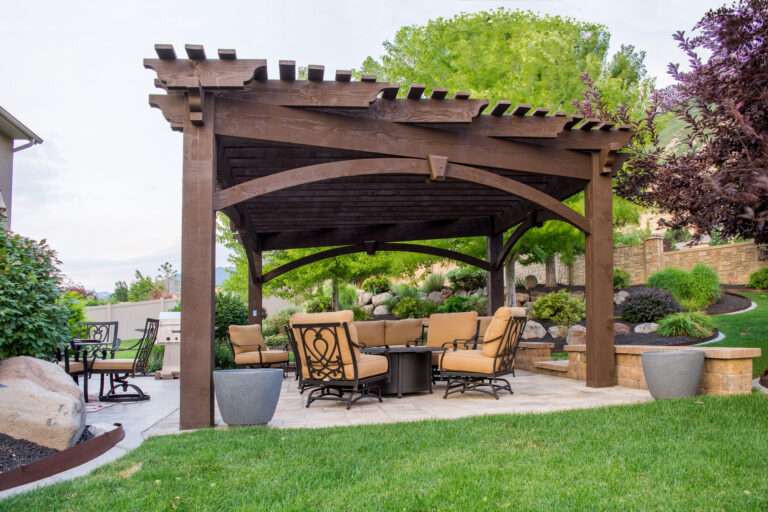
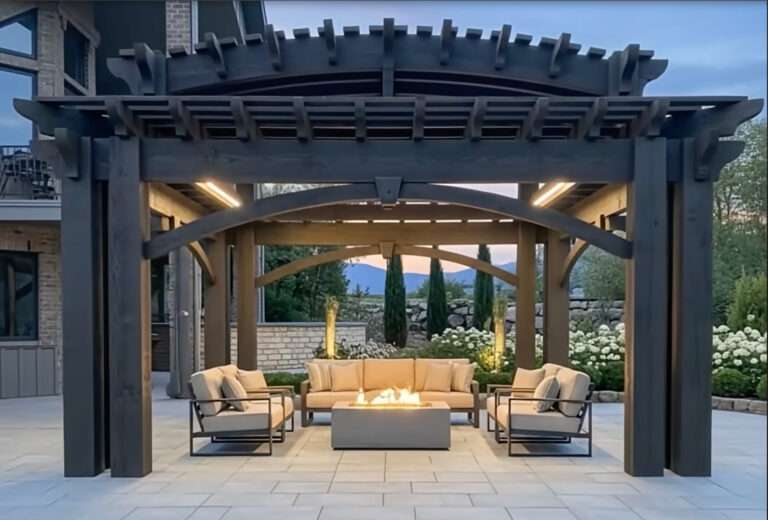
That’s why Douglas Fir is a suitable, common choice for pergola posts and beams, provided it’s finished and kept off wet ground contact, rather than a wood you’d choose for a fence post going straight into dirt.

Douglas Fir Vs. Cedar, Redwood, And Pressure-Treated Pine
Most comparisons online stop at cedar. Here’s the fuller picture, since it’s rarely all in one place.
|
Species |
Natural decay resistance |
Structural strength |
Typical exterior use |
|---|---|---|---|
|
Douglas Fir |
Moderately resistant (heartwood) |
Among the highest of the group |
Framing, beams, posts — finished and above-ground |
|
Western red cedar |
Resistant |
Moderate |
High-moisture climates, less structural load |
|
Coast redwood |
Very resistant (old growth) / moderately resistant (young growth) |
Moderate |
Old growth: premium, hard to source. Young growth: widely available, same decay tier as Douglas Fir |
|
Pressure-treated pine |
Not natural — relies on chemical treatment |
Comparable to Douglas Fir in most grades |
Ground contact, decking, budget framing |
That redwood row hides a detail most comparisons skip: the “superior to Douglas Fir” reputation belongs to old-growth stock, which is now scarce, protected in many areas, and expensive.
Nearly all Coast Redwood sold today is young growth, and the Wood Handbook rates young-growth redwood as moderately resistant — identical to Douglas Fir, not better.
Cedar and redwood get their natural durability from oils and compounds found in the heartwood — cedar has its own set of natural preservatives, and redwood relies on tannins, the same kind of protective chemistry found in Douglas Fir, just in smaller amounts. Old-growth wood tends to have more of these compounds than younger growth. Pressure-treated pine works differently — untreated pine isn’t naturally decay-resistant at all, so all of its outdoor durability comes from the chemical treatment process, not the wood itself.
Douglas Fir’s real strength is structural. It’s one of the strongest and stiffest softwoods you can build with, which is a big reason it’s such a popular choice for heavy timber framing — though pressure-treated pine, when it’s structural grade, can actually hold its own here too. That’s why the deciding factor between them usually comes down to decay resistance and how well each handles moisture over time, rather than raw strength.
If you’re weighing structural beams specifically, our breakdown of Douglas Fir vs. oak for timber pergolas covers the engineering side of that tradeoff in more depth, and our full wood species comparison for timber pergolas walks through Douglas Fir, redwood, and cedar side by side for pergola-specific decisions.
Does Climate Change Affect How Long Douglas Fir Lasts?
Yes — the Wood Handbook is explicit that decay resistance runs lower in warm, humid climates, where wood stays above that 20-to-30-percent moisture threshold for longer stretches of the year.
A Douglas Fir structure in a dry, high-desert climate has an easier time staying below the decay threshold than the same structure in a humid coastal or southeastern climate, where rainfall, humidity, and slower drying times work against it.
That doesn’t rule Douglas Fir out in humid regions — cedar and Coast Redwood exist partly to serve those climates better, which is one reason material selection and finish maintenance matter more the farther east and south you build.
It means the species decision should account for where the structure will actually stand, not just what looks good in a catalog photo.
Do You Need To Seal Or Treat A Douglas Fir Pergola?
For above-ground use, yes — a UV-rated exterior stain or sealer is standard practice, not optional.
It blocks bulk water from penetrating the grain and slows the surface breakdown that comes from sun exposure, both of which keep the wood below the moisture threshold that triggers decay.
For ground contact, the Wood Handbook’s guidance is more specific: plan on a preservative treatment, not just a surface finish.
Every Western Timber Frame structure ships with a shop-applied, UV-rated Sherwin-Williams stain already on the wood, along with hardware engineered to keep the post base off the ground where moisture collects — so the sealing question is largely handled before the kit arrives, and the structure is backed by a limited structural warranty that ranges from 3 to 25 years depending on the timber series, beginning at delivery.
A periodic stain touch-up over the years is the ongoing maintenance Douglas Fir asks for; it isn’t a one-and-done chemical treatment.
Is Douglas Fir More Rot Resistant Than Pine?
Yes, in most cases.
The pine most commonly sold as dimensional construction lumber falls into the Wood Handbook’s bottom decay-resistance tier alongside spruces and true firs, while Douglas Fir sits a full tier higher as moderately resistant.
The exception is old-growth longleaf and slash pine, which the Handbook places in the same moderately resistant tier as Douglas Fir — but that’s historic-growth material that isn’t part of today’s commercial lumber supply.
Is Douglas Fir Rot Proof, Or Just Rot Resistant?
Just resistant — no commercially available wood is rot proof, including cedar and redwood.
“Resistant” means the heartwood slows fungal decay meaningfully longer than a nonresistant species under the same conditions; it doesn’t mean immunity.
Any wood, kept wet long enough, will eventually decay, and it’s easy to misread normal weathering as failure. Our breakdown of common wood-rot myths covers a few of those misconceptions in more depth.
The moisture threshold matters more than the species label: a well-finished, well-drained Douglas Fir structure will outlast a neglected cedar one, and vice versa.
How Can You Tell If Lumber Is Heartwood Or Sapwood?
Heartwood runs darker — reddish to yellowish-brown in Douglas Fir — while sapwood is pale, almost cream-colored, near the outer rings of the log.
On a rough-cut board, that color line is usually visible to the eye. On planed, finished lumber, it’s harder to spot, so the more reliable move is asking your supplier directly whether a piece is heartwood, especially for anything going into ground contact or heavy weather exposure.
Grading stamps on dimensional lumber don’t call out heartwood content by default, which is exactly why it’s worth asking rather than assuming.
The Bottom Line On Douglas Fir And Rot
Douglas Fir heartwood is genuinely rot-resistant — just not the most rot-resistant option available, and the Wood Handbook says so in plain, citable terms.
Above ground, finished, and kept out of standing moisture, it performs well for the decades most homeowners are planning around. In ground contact or humid climates without extra protection, it needs help, either from a preservative treatment or a species swap to cedar or redwood.
The species decision comes down to where the structure stands and how it’s finished, not a single yes-or-no answer to “is Douglas Fir rot resistant.”
If you’re weighing that decision for a custom Douglas Fir pergola or a fully covered pavilion, a design consultation is the fastest way to match the species, finish, and structure to your actual site and climate — no pressure, no obligation.
With 28 Best of State Awards, multiple Inc. 5000 honors, an HGTV Design Excellence Award, 2026 SBA Utah District Manufacturing Small Business of the Year, and 7,000+ structures built nationwide since 2008, Western Timber Frame is a national authority on custom, structural, handcrafted, real-wood timber frame pergolas and outdoor structures for homeowners who want true craftsmanship, not mass-produced, cookie-cutter kits.