
Best Wood For Outdoor Structures In Utah: Why Rot Isn’t Your Real Problem
What You’ll Learn in This Blog
- Which wood species are best suited to different parts of an outdoor structure in Utah
- Why UV exposure, moisture cycling, and freeze-thaw conditions can cause more damage than rot
- How to tell normal wood checking and UV weathering from actual wood rot
- How Douglas Fir, Western Red Cedar, and Coast Redwood compare for strength, stability, and decay resistance
- Which finish and moisture-management practices help outdoor wood withstand Utah’s climate
- Why joinery, fasteners, snow loads, and wind loads matter alongside wood species when designing an outdoor structure
The best wood for outdoor structures in Utah comes down to three species: Douglas Fir for structural framing, Western Red Cedar for natural decay resistance in trim and siding, and Coast Redwood for color and stability at altitude.
None of them need to survive rot the way most builders assume — decay fungi can’t break down wood until its moisture content holds above 30 percent of the fiber saturation point.
That’s good news, and a trap at the same time.
Because rot isn’t the threat, homeowners tend to also misjudge and miss out on parts of the climate that are actually doing the damage: intense UV at elevation, wide daily temperature swings, and moisture that shows up in short, sharp bursts instead of a slow soak.
Get the species and finish schedule right, and timber in Utah holds up for decades. Get them wrong, and you’re looking at cracked, gray, fastener-streaked wood within a few seasons, wondering why the “rot-resistant” board didn’t perform the way the label promised.
What’s The Best Wood For Outdoor Structures In Utah?
Match the species to the job it’s doing, not to a rot-resistance ranking:
- Structural beams, posts, and long spans: Douglas Fir, for stiffness and strength-to-weight performance.
- Trim, siding, and fine outdoor woodwork: Western Red Cedar, for natural extractives and a workable grain.
- Posts and trim where color and stability both matter: Coast Redwood.
The sections below walk through why — starting with what’s actually driving wood damage in Utah, since the data doesn’t point to decay.
Why Isn’t Rot The Real Problem For Wood In Utah?
Decay fungi need wood saturated near its fiber saturation point, roughly 30 percent moisture content, to break down cell walls — a level that requires sustained wetness, not an occasional storm.
Utah’s climate rarely produces that kind of sustained wetness.
The Sierra Nevada and Rocky Mountains block most Pacific and Gulf moisture from reaching the state, and statewide precipitation averages about 13.4 inches a year, with some areas getting under 5 inches.
Rot still shows up, but usually in specific trouble spots: sprinkler overspray hitting the same post face every day, snowmelt pooling where a beam meets a foundation, or unsealed end grain left to wick water straight into the fibers.
If you’re seeing the soft, dark, crumbling texture of wet rot or dry rot, it usually traces back to one of those localized moisture traps, not the climate as a whole.
Each one leaves a different signature, and none of them mean the wood has failed.
If it’s not fungus, three mechanisms are doing the real work: UV breakdown, moisture cycling, and stress at the fasteners.
Each one leaves a different signature, and none of them mean the wood has failed.
How Does UV Exposure Break Down Wood?
Utah’s elevation means outdoor wood sits under more intense UV than it would at sea level, since the UV index climbs with altitude. That radiation breaks down lignin, the compound that binds wood fibers together and gives timber its color.
Once lignin degrades at the surface, wood turns gray, and the surface fibers loosen.
It’s a cosmetic, surface-level change — and exactly what a UV-rated finish is built to slow down, which is why the finish schedule matters more here than in a shaded, humid climate.
Is Wood Checking The Same Thing As Rot?
No. Checking is a separation along the grain caused by the surface drying and shrinking faster than the core, and it’s a normal response in solid timber, not a sign of failure.
Here’s how to tell the three apart at a glance:
|
What You See |
What It Actually Is |
What Causes It |
Structural Concern? |
|---|---|---|---|
|
Fine cracks running with the grain, surface turning gray |
Checking + UV weathering |
Surface moisture leaving faster than the core can equalize, plus lignin breaking down in sunlight |
No — cosmetic, normal in solid timber, more common in larger members |
|
Soft, spongy, or crumbling wood, often dark and damp to the touch |
Wood rot (fungal decay) |
Sustained moisture content near 30%, usually at a poorly sealed joint or ground contact |
Yes — needs inspection and likely repair |
|
Peeling, chalking, or flaking coating with solid wood underneath |
Finish failure |
UV and thermal cycling breaking down the coating faster than the timber itself |
No — refinish only, wood is unaffected |
Larger timbers check more than smaller ones simply because they hold more moisture at the core relative to the surface. That’s a known tradeoff of heavy timber, not a defect in the material.

What Role Do Freeze-Thaw Cycles And Fasteners Play?
Utah’s shoulder seasons don’t just deliver a single winter freeze. Nearly every weather station in the state has a distinct first fall freeze and a distinct last spring freeze, months apart — a pattern the Utah Climate Center tracks specifically because temperatures cross the freezing mark repeatedly, not once.
Each of those crossings expands and contracts both the wood and any exposed metal connecting it, and over years, that repeated movement is what loosens joints and corrodes exposed fasteners — not fungus.
This is where design matters as much as species.
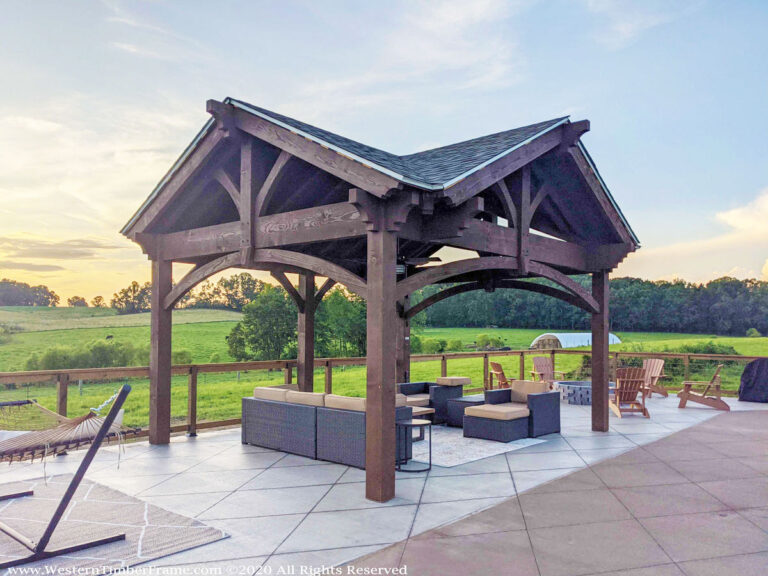
Structures held together with exposed metal brackets give water and temperature swings a direct path to rust and loosen at every connection point. The Dovetail Difference®, Western Timber Frame’s patented joinery (US Patent No. 9,797,149 B2), interlocks heavy timbers without exposed metal brackets or fasteners, removing that specific failure point at the connection.
Snow load and wind pressure add another variable that has nothing to do with rot resistance.
Every structure needs to be engineered to its project’s local snow and wind loads, and that engineering documentation to support permitting looks different in Park City’s heavy mountain snowpack than it does in St. George’s desert heat — worth confirming before you commit to a design.

How Do Douglas Fir, Cedar, And Redwood Actually Compare?
On paper, cedar’s natural decay resistance sounds like the automatic winner.
In practice, the right species depends on what the piece is doing: carrying structural load, or standing up to weather as trim and siding.
|
Species |
Strength & Stability |
Natural Decay Resistance |
Best Use in Utah |
Tradeoff |
|---|---|---|---|---|
|
Douglas Fir |
Highest stiffness of any Western softwood; the benchmark framing species |
Moderate, and concentrated in the heartwood — not a substitute for a maintained finish |
Structural beams, posts, and long spans |
Needs a UV-rated finish kept current; heartwood resistance alone isn’t enough for ground contact |
|
Western Red Cedar |
Lighter and softer than Douglas Fir, dimensionally stable in dry air |
Real, extractive-based resistance from compounds like plicatic acid |
Trim, siding, and fine outdoor woodwork |
Softer surface dents and scratches more easily than Douglas Fir |
|
Coast Redwood |
Comparable stability to cedar, with deeper natural color |
Old-growth heartwood rates resistant to very resistant; most structural-grade stock sold today is younger growth with more moderate resistance |
Posts and trim where color and stability both matter |
Costs more and is less widely available than Douglas Fir or cedar |
That heartwood-versus-sapwood distinction matters across all three species, not just redwood — natural decay resistance lives in the heartwood, and none of it substitutes for a maintained finish on a piece that’s actually exposed to weather.
For a full breakdown of how Douglas Fir stacks up structurally against other species, see the engineering comparison of Douglas Fir versus oak, or the full side-by-side of Douglas Fir, redwood, and cedar if trim and siding species are also on the table.

How Do You Protect Outdoor Wood From Utah’s Climate?
Protection in Utah is about slowing UV breakdown and managing moisture at specific points, not preventing rot across the whole structure. Three things matter most.
A pigmented, penetrating stain with real UV blockers holds up longer than a clear film finish, which tends to peel once the desert sun gets underneath it. Sealing end grain and keeping posts off direct ground or standing snowmelt closes off the two spots where moisture actually accumulates.
EarthAnchor™, the corrosion-resistant aluminum foundation hardware used under every pergola we build, keeps the post base off direct ground contact for exactly this reason.
Plan on washing and re-coating the finish every 12 to 24 months depending on sun exposure. That’s a finish-maintenance schedule, not a wood-replacement schedule — the timber underneath is built to outlast several rounds of refinishing.
The Real Decision Isn’t Rot Resistance
Once you separate checking, UV weathering, and finish failure from actual rot, the wood-species decision gets a lot clearer.
It comes down to what a piece is doing structurally, how much UV and moisture cycling it will see, and whether the joinery holding it together gives water and temperature swings a way in at the fasteners.
If you’re still weighing which type of structure fits the space before you get to species, that’s a reasonable place to start too.
With 28 Best of State Awards, multiple Inc. 5000 honors, an HGTV Design Excellence Award, 2026 SBA Utah District Manufacturing Small Business of the Year, and 7,000+ structures built nationwide since 2008, Western Timber Frame is a national authority on custom, structural, handcrafted, real-wood timber frame pergolas and outdoor structures for homeowners who want true craftsmanship, not mass-produced, cookie-cutter kits.