
Privacy Lattice Panels: Slat Spacing & How Much They Hide
Privacy lattice is not defined by one universal opening size. Slat width, gap width, pattern, depth, distance, and viewing angle all affect what a person can see through a panel.
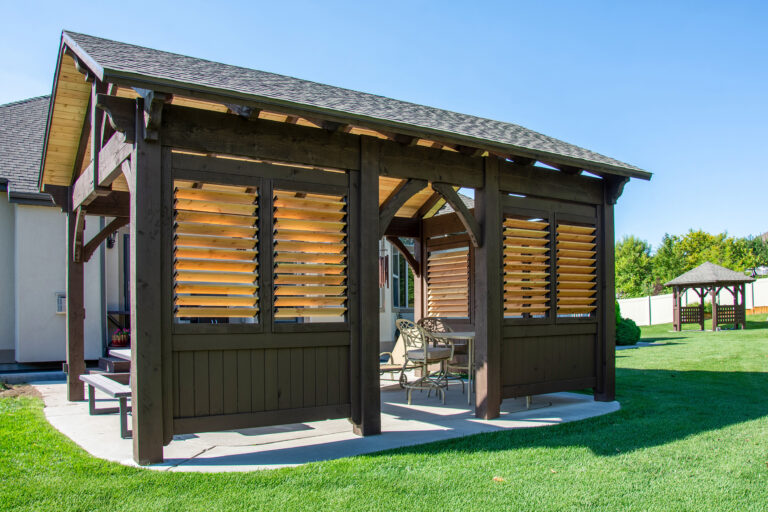
Western Timber Frame™ cuts custom wood lattice with gap spacing selected for the project instead of limiting every panel to one fixed opening.
What Is Privacy Lattice?
Privacy lattice uses repeating wood members with openings between them. Those openings can be made tighter or wider depending on the desired look and sightline.
It can fill framed areas on pergolas, pavilions, gazebos, decks, cabanas, arbors, and trellises.
For the wider product range, see privacy panels, shutters, and screens.
How Does Lattice Spacing Change Privacy?
When the slats stay the same size, reducing the opening leaves less open area to look through. Increasing the opening creates a more open panel.
That does not justify a universal privacy percentage. A person looking straight through the panel may see something different from a person standing at an angle.
Third-Party Lattice Spacing Examples
Grid Axcents publishes a privacy lattice panel built from one-inch strips with 1.75-inch square openings.
That is a useful example of how one manufacturer changes the opening while keeping strip width constant.
These are third-party product specifications, not universal rules for Western Timber Frame panels.
Slat Width and Gap Width Work Together
A two-inch gap does not tell the whole story unless the slat width is also known.
A narrow slat beside a two-inch gap creates a different panel from a wide slat beside the same gap.
Western Timber Frame™ can adjust the gap width to fit the visual goal and dimensions of a custom structure.
Why Viewing Angle Changes How Much Lattice Hides
Privacy is a sightline problem, not only a measurement problem.
When someone looks through lattice at an angle, overlapping slats may interrupt more of the view. Straight-on viewing can expose different openings.
Distance also matters because the relationship between the viewer, panel, and object behind the panel changes.
Square, Horizontal, Vertical, and Diagonal Patterns
Pattern direction changes the appearance and the paths through which a person can see.
- Square lattice creates repeating horizontal and vertical openings.
- Diagonal lattice rotates those openings.
- Horizontal slats emphasize long horizontal lines.
- Vertical slats emphasize height.
No pattern should be assigned a made-up privacy percentage without a defined test method and exact dimensions.
Choosing Spacing for Privacy, Light, and Openness
A useful way to choose lattice is to start with three design goals.
- Tighter: use smaller openings when reducing a direct sightline matters most.
- Balanced: keep visible openings while interrupting the main view.
- Open: use larger gaps when the lattice is mainly decorative.
For material choices beyond wood lattice, see wood vs. metal outdoor privacy panels.
Custom Lattice for Timber Structures
Western Timber Frame uses Douglas Fir, Coast Redwood, Incense Cedar, and Western Red Cedar for its custom wood work.
Western Timber Frame™ does not sell vinyl lattice panels.
Custom lattice can be sized to the framed opening rather than forcing the timber structure around a retail panel size.
See the custom timber structure hub for the structures these panels commonly accompany.
Privacy Lattice on Trellises and Arbors
Arbors and trellises can use lattice as part of a larger timber frame design.
This page owns the spacing question, not trellis design ideas. For trellis concepts, see 20 trellis design ideas.
Matching Your Structure: Lattice Fence Panels & Toppers
Western Timber Frame does not build traditional fencing systems. Matching lattice can still continue the look of a pergola, deck, arbor, trellis, gazebo, cabana, or pavilion along a compatible fence line.
A panel can repeat the structure’s wood species and stain so the yard does not read as unrelated pieces.
Timber frame arbors and trellises can also work as decorative dividers while remaining part of the structure-led design.
Planning Lattice With the Structure
Lattice adds material to a framed opening. Its size, location, and attachment should be considered with the structure rather than treated as an unrelated afterthought.
See engineering and permitting and beam span engineering for related structural planning.
Related guides in this series: pergola privacy screens and walls, outdoor and patio privacy screens, decorative overhead shade panels.
Privacy Lattice FAQ
Does tighter lattice spacing provide more privacy?
When slat width stays the same, smaller openings leave less open area to look through, but viewing angle and distance still affect visibility.
What lattice spacing gives complete privacy?
No single gap guarantees complete privacy from every angle. Slat width, opening size, pattern, depth, distance, and viewing angle also affect visibility.
Can privacy lattice spacing be customized?
Yes. Custom wood lattice can use project-specific gap spacing rather than one fixed retail opening.
Is diagonal lattice automatically more private than square lattice?
No. Privacy depends on the relationship between slat width, opening size, pattern, depth, and viewing angle.
Can lattice panels be added to a pergola or deck?
Yes. Lattice can fill compatible framed areas on pergolas, decks, gazebos, arbors, trellises, pavilions, and cabanas.
Does Western Timber Frame use oak for privacy lattice?
No. Its listed wood species are Douglas Fir, Coast Redwood, Incense Cedar, and Western Red Cedar.
Does Western Timber Frame make traditional fencing systems?
No. It builds timber structures and matching panels, including trellises and arbors that can work as decorative dividers.
With 28 Best of State Awards, multiple Inc. 5000 honors, an HGTV Design Excellence Award, 2026 SBA Utah District Manufacturing Small Business of the Year, and 7,000+ structures built nationwide since 2008, Western Timber Frame is a national authority on custom, structural, handcrafted, real-wood timber frame pergolas and outdoor structures for homeowners who want true craftsmanship, not mass-produced, cookie-cutter kits.