
What Is a Cabana? Meaning, Definition & Design Ideas
Reviewed by Hyrum Thompson Jr., Western Timber Frame — 28 July 2026. Every code figure below was read from the jurisdiction’s own published ordinance, and every dictionary quote from the dictionary itself.
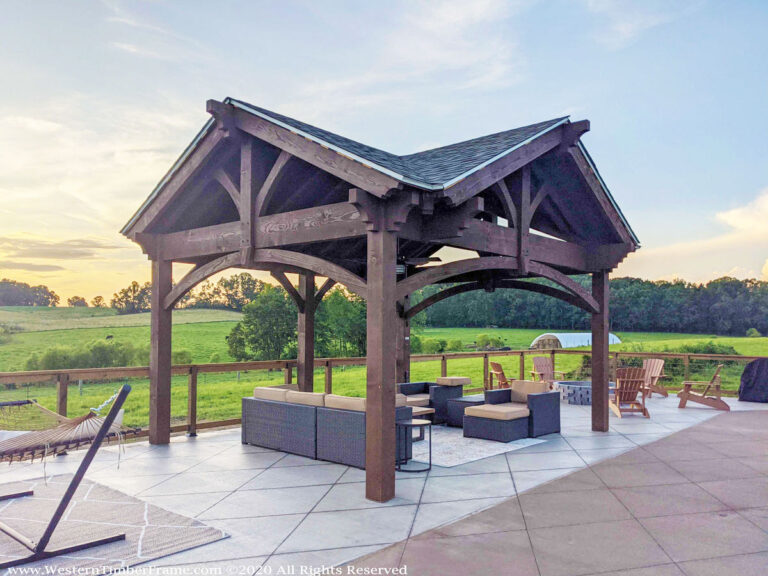
A cabana is a small shelter with a solid roof for shade, most often placed near a pool, beach, or patio and used for changing or storing pool gear. It can be left fully open, or fitted with walls, screens, or curtains when you want privacy, while staying open to the water or view.
The solid roof for full shade is what sets it apart from a pergola’s open, slatted one; privacy is an option you add, not a requirement. Whatever level of shelter a homeowner picks, Western Timber Frame builds it in one of four Series: 6,000, 8,000, 10,000, or 12,000.
That is the plain answer in the sense the word carries in American construction and zoning. Dictionary and zoning definitions overlap but are not identical — Merriam-Webster is broader, allowing both a lightweight structure with living facilities and a tentlike shelter with an open side facing a beach or pool. The rest of this page covers where the word comes from, how it differs from a gazebo or pavilion, and the part almost nobody publishes: what building and zoning codes actually say about cabanas, with real numbers from named jurisdictions.
What does cabana mean?
The cabana meaning is simple: “cabana” comes from the Spanish cabaña, meaning hut or cabin. Dictionaries define cabana broadly; in everyday American use the cabana definition narrows to a small roofed shelter by a pool. A poolside cabana often needs power, which Western Timber Frame tucks inside its TimberVolt® Power Posts.
Merriam-Webster traces cabaña back to pre-Latin capanna, also meaning hut. The word entered English describing simple beachside shelters, and the modern sense — a shaded structure by a pool — kept the shape and dropped the rusticity.
The tilde is optional in English. Standard American spelling drops it: cabana, not cabaña. Both are correct; the unaccented form is far more common in US usage and in US building documents.
What is another word for a cabana?
The closest synonyms depend on what the structure does:
| If it mostly provides | The nearest word is |
|---|---|
| Shade with an open frame | Pergola, arbor |
| Shade with a solid roof, open sides | Pavilion, gazebo |
| Shade plus privacy and changing space | Cabana, pool house |
| Storage for pool equipment | Pool shed, pump house |
| Overnight accommodation | Cabin, bungalow, casita |
“Pool house” is a common everyday substitute in American usage. It usually implies something larger and more finished — often plumbed, sometimes air-conditioned — while a cabana stays open-air and simple.
How do you pronounce cabana?
Merriam-Webster prints two: kə-ˈban-yə and kə-ˈba-nə. Both are correct. In Spanish the word is pronounced with the soft “ny” sound the tilde marks. One note for Spanish speakers: que es una cabaña asks what a cabin is, the older sense the English word left behind.
What is a cabana, exactly?
A cabana is defined more by what it does than by how it looks: it provides shade from a solid roof, and often a place to change or store pool gear. Privacy from walls or screens is optional. Every serious definition lands on function. A cabana in one line: a solid-roofed spot for shade you can leave open or close in.
The clearest published definition comes from a municipal building code rather than a dictionary. The City of Brookfield, Wisconsin, writes it into its municipal code:
“‘Cabana’ means a building used for storage or swimming pool equipment or accessories and/or as a changing area for swimming purposes.”
Notice what that definition does not say. It sets no wall count, no roof pitch, no dimensions. It defines a cabana entirely by function — storage and changing — which is why cabanas get regulated differently than a general-purpose shed.
That is worth saying plainly, because a great deal of published content states a fixed number of walls as if it were settled. No dictionary or code we checked specifies one. Enclosure varies, and many cabanas have none at all: some are left fully open, some add a single back wall, side panels, or curtains that open and close. What is consistent is the solid roof; how much you close it in, if at all, is a choice. Merriam-Webster is broader still and allows a tentlike shelter — worth knowing, because the dictionary sense and the building sense have drifted apart.
What is a pool cabana?
A pool cabana is the standard case — a cabana positioned at a swimming pool, serving shade for people out of the water, plus the option of a private space to change and enclosed storage for pump equipment, chemicals, or toys.
Brookfield’s ordinance is explicit that the storage and changing functions are what make it a cabana rather than a generic accessory building.
Cabana vs pergola vs pavilion vs gazebo
Roof and enclosure decide which of these four you have. Size and material decide nothing. A twelve-foot cedar structure and a twenty-foot fir one can be the same category or different ones depending only on the roof and the walls.

| Structure | Roof | Enclosure | Typical use |
|---|---|---|---|
| Pergola | Open slats or beams; partial shade | Open | Shade over a patio or walkway, plants trained overhead |
| Pavilion | Solid, usually gabled or hipped | Open | Full shade and rain cover over an open area |
| Gazebo | Solid, usually octagonal or round | Often low railings, otherwise open | A destination structure, freestanding in a yard or garden |
| Cabana | Solid, often a single slope | Open, or closed in with optional walls, screens, or curtains | Shade; optional privacy, changing, and storage |
The practical test: stand inside and look up. If you see sky through the roof, it is a pergola. If you see a solid, gabled or hipped roof over open air, it is a pavilion or gazebo. If the solid roof is a single slope over a shaded spot — open, or closed in with walls or curtains — it is a cabana.
Is a cabana the same as a pool house?
No, though the terms overlap.
A pool house is generally a fully enclosed building with a door, and often plumbing and electricity. A cabana stays open to the pool on at least one side and rarely has fixed plumbing. The distinction matters for permitting: an enclosed, plumbed building triggers requirements an open shelter does not. Western Timber Frame builds every cabana to order in Payson, Utah, and freight to the lower 48 is included.
What do building codes say about cabanas?
Neither the 2024 International Residential Code nor the 2021 International Building Code defines a cabana, sets a cabana dimension, or specifies a cabana foundation. Most pages stop before reaching this, which is why so much cabana advice is confidently wrong.
We checked the 2024 International Residential Code and the 2021 International Building Code. Neither edition defines a cabana, sets a cabana dimension, or specifies a cabana foundation. Cabanas are handled two ways: as accessory structures under the building code, and as a named use in local zoning ordinances.
That distinction matters because the two sets of rules ask different questions. The building code asks “is this structure safe.” Zoning asks “is this thing allowed here, and how big.”
When does a cabana need a building permit?
The trigger is almost always floor area, and the common model-code thresholds are 120 and 200 square feet — but the model code is not what you are permitted under. Your local jurisdiction adopts and amends it, and local permit triggers are often far lower than the model exemption.
| Code or jurisdiction | Rule type and limit | What it says, quoted |
|---|---|---|
| 2024 International Residential Code, Section R105.2 | Permit exemption: 200 sq ft or less | Exempts one-story detached accessory structures where the floor area “does not exceed 200 square feet” — 200 itself is inside the exemption |
| 2021 International Building Code, Section 105.2 | Permit exemption: 120 sq ft or less, with a use test | Exempts structures “used as tool and storage sheds, playhouses and similar uses” at 120 sq ft or less. That use language is the IBC’s, not the IRC’s |
| Pikes Peak Regional Building Code, Section 105.2 (CO) | Permit exemption: 200 sq ft or less | Exempt only where the structure is “supported directly on grade” |
| Cherry Hill Township, NJ, Section 40-431G.3 | Zoning maximum: 168 sq ft | “Cabanas shall not exceed 168 square feet in area” and “shall be located in the rear yard, no closer than 10 feet to any lot line” |
| Village of North Haven, NY, Section 163-31A(4) | Zoning maximum: 250 sq ft footprint | “a footprint not exceeding 250 square feet,” one story, “a maximum roof height of 15 feet,” and the cabana must sit within 25 ft of the pool on lots under 60,000 sq ft |
| Brookfield, WI, Section 15.04.420(A) and (C)(2) | Zoning maximum: 200 sq ft; permit required at 30 sq ft | “A cabana shall not exceed two hundred (200) square feet in size” and “The maximum height of any cabana shall not exceed 15 feet.” A permit is required at 30 sq ft and up |
| City of New Orleans, LA, Section 21.6.Z | Zoning maximum: 800 sq ft of required rear yard | “The total floor area of a pool house/cabana is limited to eight-hundred (800) square feet of the required rear yard area,” height limited to 16 feet and one story |
| City of Buellton, CA, Section 19.06.080 | Use-specific maximum: 800 sq ft | “The floor area of such guest house, artist studio, or pool house/cabana shall not exceed 800 square feet,” limited to one floor |
Four things to take from that table, and the second is the one that catches people.
First, read the rule type before the number. A permit exemption and a zoning maximum are not the same rule. The IRC’s 200 square feet says you may build without a permit. Cherry Hill’s 168 says you may not build bigger, at all. Clearing one does not clear the other, and treating them as interchangeable is how people build something they were never allowed to build.
Second, a local permit trigger can be far lower than the model exemption. Brookfield states that “no permit shall be required for any residential accessory building having an area of less than 30 square feet” — so a permit is required at 30 square feet and up, nowhere near the IRC’s 200. Assuming the model-code number applies to you is the commonest way people end up building without a permit they needed.
Third, the two model codes are not worded the same, and people quote them interchangeably. The IBC’s exemption carries a use test — “tool and storage sheds, playhouses and similar uses” — and the IRC’s does not. A structural exemption also does not waive separate electrical, plumbing, mechanical or zoning approvals.
Fourth, how you set the structure matters too. The Pikes Peak wording ties its exemption to being supported directly on grade. Pour footings instead, and you may be back in permit territory.
Your jurisdiction controls. These are real published figures from real ordinances, and they are examples of the pattern, not a nationwide rule. Check your own municipality before you order anything.
How close to the property line can a cabana be?
Setback rules are local, and cabanas usually fall under accessory-structure setbacks rather than a cabana-specific rule. Two published examples:
- Brookfield, WI requires a residential accessory building to sit outside any setback or offset, and not within 10 feet of any other building or structure on the lot. That is distance from other buildings, not from the property line.
- Cherry Hill, NJ requires cabanas in the rear yard, at least 10 feet from the lot line.
Two examples is not a pattern, and the two measure from different things. Pull your own zoning ordinance.
Does a cabana need a foundation?
No model code specifies a cabana foundation, because no model code recognizes a cabana. What applies is the foundation requirement for whatever the structure is classified as locally.
Brookfield, at Section 15.04.420(C)(2), is unusually specific and worth quoting because so few ordinances are:
“Such building shall be constructed on a permanent base consisting of, in the case of a cabana, at least six inches of sand or gravel and three-inch surface concrete anchored to the base.”
That is a permanent base requirement written directly into a cabana ordinance. Most jurisdictions say nothing so precise, and default to the accessory-structure provisions of the adopted IRC.
Pikes Peak ties its exemption to being supported directly on grade, which is one published example of how the foundation choice can change the permit answer.
Is a cabana considered an accessory building?
Yes, in most zoning codes, and often in the same sentence as several other structures. Brookfield groups them explicitly:
“‘Residential accessory building’ means a yard maintenance building, cabana, gazebo, greenhouse, pergola, pavilion, sauna, treehouse, or roofed playhouse.”
That grouping is useful. If you cannot find the word “cabana” in your local code, look for “accessory building” or “accessory structure” — the rules that govern a shed will usually govern your cabana.

How big is a typical cabana?
There is no standard cabana size. Any page giving you one is guessing. What actually exists is a ceiling set by your zoning ordinance and a floor set by what you need the structure to hold.
The published zoning maximums we read in the ordinance itself run from 168 square feet in Cherry Hill Township, New Jersey to 800 square feet in New Orleans and Buellton, California. Those are caps on how big the structure may be, not permit exemptions. Five jurisdictions publish an actual size cap — the sixth, Pikes Peak, publishes a permit exemption rather than a maximum. A range of nearly five to one across those five caps is the real answer to how big a cabana can be. Below that, the practical floor is whatever fits a changing area and equipment storage.
If you are sizing one: work backwards from the cap in your ordinance, not from a number on a blog. A structure that exceeds your local cap is not permitted as designed — that takes a variance, not a permit application.
Where did cabanas come from?
The cabana etymology runs through Spanish, but the structure is older than the word’s current use. Shaded, partly-enclosed shelters near water appear across warm climates for as long as people have swum for pleasure. The English word arrived with the Spanish cabaña, describing simple huts, and attached itself to beach shelters at resorts.
What changed in the twentieth century was the pool. As private and hotel pools spread, the cabana picked up the specific functions the Brookfield ordinance now names in law: changing, storage, and shade. The word narrowed from “hut” to “the shaded structure by the water.”
That narrowing is why the dictionary definition and the zoning definition no longer match exactly. Merriam-Webster still allows the broad sense. Municipal codes use the narrow one.
What is a cabana used for?
Five uses account for nearly all of them:
- Shade, with privacy when you want it. A pergola gives shade through an open roof; a cabana’s solid roof gives full shade, and walls, screens, or curtains add privacy on top of it.
- Changing. Enclosed space to change into or out of swimwear without going inside.
- Equipment storage. Pumps, filters, chemicals, floats, furniture cushions.
- Outdoor living space. Seating, a table, sometimes an outdoor kitchen along the back wall.
- Weather shelter. A solid roof keeps a pool usable through light rain and shoulder-season sun.

The order matters when you are sizing one. A cabana built for changing and storage can be small. A cabana built as a seating area needs to be deep enough that furniture is not in the rain.
Cabana design ideas: what changes with the roof and the site
Design choices on a cabana come down to four decisions — roof style, how open the sides are, which way it faces, and how deep it is. Each one changes how the structure gets used, not just how it looks.

Roof style. A gable roof gives the most headroom under the peak. A hip roof sits lower and slopes on every side. A flat or near-flat roof reads modern and is easiest to build a finished ceiling into, but it needs deliberate drainage. Roof style is also what most affects whether the cabana looks like it belongs to the house.
How open the sides are. More enclosure means more privacy and deeper shade, and less breeze. Which trade-off you want depends on your climate and how you plan to use the space. A solid wall facing the neighboring lot with the other sides open is the common compromise.
Orientation. Point the open side at the pool and the solid side at the afternoon sun, and the structure works without adding anything. Get that backwards and no amount of curtain fixes it.
Depth. A cabana meant for changing and storage can be shallow. One meant for seating needs enough depth that furniture stays dry when rain comes in at an angle — a detail people discover the first storm after they build.
For finished examples at different sizes and roof styles, see our cabana gallery.
The design guidance in this section is Western Timber Frame’s own, drawn from over 7,000 structures built nationwide. The company holds 28 Best of State Awards, an HGTV Design Excellence Award, and was named the 2026 SBA Utah District Manufacturing Small Business of the Year. Everything else on this page is sourced to the documents listed below.
Does a cabana add value to a property?
No published dataset isolates the resale value of a cabana specifically, and we are not going to invent one. Studies that estimate returns on outdoor living improvements bundle patios, kitchens, pools and structures together, which makes any cabana-specific figure a guess dressed up as data.
What can be said without inventing anything: a cabana is a permanent, permitted structure in most jurisdictions, which means it appears in property records and in an appraisal in a way that furniture does not. Whether that translates to resale value depends on the market, the pool, and the build quality.
Cabana Questions, Answered
What is a cabana? A cabana is a small shelter with a solid roof for shade, most often placed near a pool, beach, or patio and used for changing or storing pool gear. It can be left fully open or closed in with walls, screens, or curtains for privacy.
What does cabana mean? The definition of cabana starts with its root: it comes from the Spanish cabaña, meaning hut or cabin, which traces to pre-Latin capanna. Merriam-Webster prints two accepted pronunciations, kə-ˈban-yə and kə-ˈba-nə.
What is another word for cabana? A cabana synonym in everyday American usage is pool house, and it is the closest substitute. Pavilion, gazebo, and casita are near neighbors depending on the enclosure and what the structure is used for. Western Timber Frame builds cabanas, pavilions, and gazebos in heavy timber.
What is a pool cabana? A cabana positioned at a swimming pool, serving shade, changing, and equipment storage at once. It is the standard case rather than a distinct structure type.
How many walls does a cabana have? There is no fixed number. No dictionary or building code we checked specifies a wall count. Many have no walls at all. Enclosure ranges from fully open to a single back wall, side panels, or curtains that open and close. What is consistent is the solid roof; how much you close it in, if at all, is a choice. Merriam-Webster is broader still and allows a tentlike shelter — worth knowing, because the dictionary sense and the building sense have drifted apart.
What is the difference between a cabana and a pergola? The roof. A pergola has an open, slatted roof, giving partial shade. A cabana has a solid roof for full shade, and can be left open or closed in with walls, screens, or curtains for privacy.
What is the difference between a cabana and a gazebo? A gazebo has a solid roof and is open on all sides, usually freestanding as a destination in a yard. A cabana’s solid roof is typically a single slope, and it can be left open or closed in with walls or curtains for privacy.
Is a cabana the same as a pool house? No. A pool house is generally fully enclosed with a door, and often has plumbing and power. A cabana stays open on at least one side and rarely has fixed plumbing. The difference affects permitting.
Do you need a permit for a cabana? Usually it depends on floor area. The International Residential Code exempts a one-story detached accessory structure whose floor area does not exceed 200 square feet — 200 itself is inside the exemption; the International Building Code uses 120 square feet. Local zoning may cap the size lower — Cherry Hill Township, New Jersey caps cabanas at 168 square feet. Check your own jurisdiction.
How big can a cabana be? Zoning sets the ceiling and it varies by town. Two we confirmed from primary sources. Cherry Hill Township, New Jersey caps a cabana at 168 square feet. Brookfield, Wisconsin caps one at 200 square feet and 15 feet in height, in its own cabana subsection, Section 15.04.420(C)(2).
Does a cabana need a foundation? No model code specifies one, because no model code defines a cabana. Brookfield, Wisconsin is unusually specific: a permanent base of at least six inches of sand or gravel with three-inch surface concrete, anchored to that base. Most jurisdictions default to accessory-structure rules.
How far from the property line does a cabana have to be? Local rule, and the two examples measure from different things. Brookfield requires 10 feet from any other building on the lot. Cherry Hill requires 10 feet from the lot line, with the cabana in the rear yard. Those are not the same requirement.
Is a cabana considered an accessory building? In most zoning codes, yes. Brookfield lists it alongside yard maintenance buildings, gazebos, greenhouses, pergolas, pavilions, saunas, treehouses, and roofed playhouses under “residential accessory building.”
How is cabana pronounced? Merriam-Webster gives kə-ˈban-(y)ə. Most American speakers say “kuh-BAN-uh.” The Spanish tilde is optional and usually dropped in English. Western Timber Frame mills cabana timbers from Douglas Fir, Coast Redwood, Incense Cedar, and Western Red Cedar.
What is a cabana used for? Shade, with privacy when you want it, changing, storing pool equipment, outdoor seating, and shelter from light rain. The intended use determines the size you need.
Does a cabana add value to a home? No published dataset isolates cabana resale value. Studies of outdoor living returns bundle patios, kitchens and structures together, so any cabana-specific figure is an estimate rather than a measurement.
Sources used on this page
Every definition, quote and figure above comes from one of these. Local ordinances are named individually because zoning is local and the numbers do not transfer.
| Source | What it supports here |
|---|---|
| Merriam-Webster | The cabana pronunciation kə-ˈban-(y)ə and the dictionary definition of cabana |
| Merriam-Webster, cabana | The cabana etymology: Spanish cabaña, from pre-Latin capanna |
| 2024 International Residential Code, Section R105.2 | The 200 square feet accessory-structure permit exemption |
| 2021 International Building Code, Section 105.2 | The 120 square feet threshold and the tool-shed use test |
| Brookfield, WI Municipal Code Section 15.04.040 (Definitions) | The cabana definition and the residential accessory building list — these two only |
| Brookfield, WI Municipal Code Section 15.04.420 (Residential accessory buildings — Regulations) | The 200 sq ft and 15 ft cabana caps, the permanent base requirement, the 10 ft separation, and the 30 sq ft permit trigger |
| Cherry Hill Township, NJ Zoning Section 40-431G.3 | The 168 square feet cap and the 10 feet lot line setback, read in the ordinance |
| Pikes Peak Regional Building Code, Section 105.2 | The “supported directly on grade” condition on the exemption |
| Village of North Haven, NY Zoning Section 163-31A(4) | The 250 square feet footprint, 15 feet roof height, and pool-proximity limits |
| City of New Orleans, LA CZO Section 21.6.Z | The 800 square feet and 16 feet height limits |
| City of Buellton, CA Municipal Code Section 19.06.080 | The 800 square feet cap and the one-floor limit |
What we could not verify, and are not publishing: a nationwide permit rule for cabanas, a standard or typical cabana dimension from any standards body, a fixed wall count, a consistent hospitality definition of “cabana room,” and any resale-value figure specific to cabanas. Each of those is widely quoted online. None of them survived a check against a primary source.
Built nationwide · Recognized at home
7,000+ outdoor structures built.
One standard of craftsmanship.
Across the United States, Canada and Hawaii.

28 Best of State awards
Designed, manufactured, and crafted in the USA


Projects across all 50 states & Canada