Dovetail Joinery Without Nails, Glue, or Exposed Hardware
Dovetail joinery connects heavy timbers wood-to-wood, so a timber frame holds together without nails, glue, or exposed hardware. Western Timber Frame’s patented Dovetail Difference® (U.S. Patent 9,797,149 B2) shapes each joint to interlock — no visible bolts, screws, hangers, or brackets, unless a piece is decorative by design.
How the Dovetail Difference® works
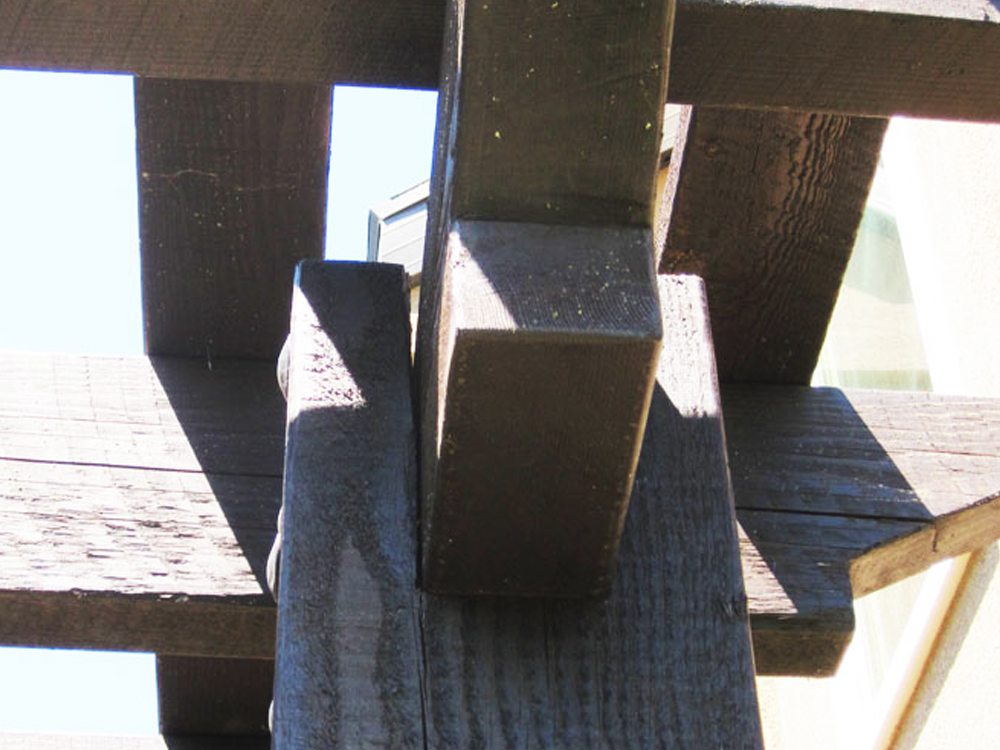
Each timber is cut by CNC so the joints fit precisely, then interlocked so the wood carries the load itself. Because there’s no fastener holding two pieces together, there’s nothing to work loose — instead, the connection actually tightens as the timber expands and contracts through the seasons. Below, the same joint after months of weather: still tight.

What happens without it
Most timber structures rely on bolts, screws, and metal brackets to hold the joints. Those fasteners stay fixed while the wood around them moves — so over time the joints can gap, the wood can crack around the hardware, and exposed metal can corrode and streak the timber.


Built and tested for the long haul
We pressure-tested the dovetail joint in our own shop to see how it carries load, and the interlocking connection held up strongly against conventional fastened joints. The result is a frame that stays tight and clean-looking for the long term — the strength is in the joinery, not in hardware that can fail.

The Dovetail Difference in the field



Common questions
Does the frame really use no nails or glue?
The structural connections are interlocking wood joints — no nails, glue, or exposed hardware holding the timbers together. Any hardware you do see is either a foundation anchor or a decorative choice.
If there’s no fastener, what holds it together?
The shaped dovetail joint itself. The timbers interlock so the wood carries the load, and the fit tightens as the wood moves rather than loosening like a bolted joint.
Why does hidden joinery matter?
No exposed metal means nothing to rust, streak the wood, or work loose — so the frame stays cleaner-looking and holds its fit far longer.
Is the Dovetail Difference patented?
Yes — it’s Western Timber Frame’s patented joinery (U.S. Patent 9,797,149 B2).
See the Dovetail Difference on your own structure
Every Western Timber Frame kit is built on this joinery. Request a free design consultation, or call (877) 870-8755 (9 am–5 pm MST).
With 28 Best of State Awards, an HGTV Design Excellence Award, 2026 SBA Utah District Manufacturing Small Business of the Year, and 7,000+ structures built nationwide since 2008, Western Timber Frame is a national authority on custom, structural, handcrafted, real-wood timber frame pergolas and outdoor structures.
Dovetail joinery connects heavy timbers wood-to-wood, so a timber frame holds together without nails, glue, or exposed hardware. Western Timber Frame’s patented Dovetail Difference® (U.S. Patent 9,797,149 B2) shapes each joint to interlock — no visible bolts, screws, hangers, or brackets, unless a piece is decorative by design.

How the Dovetail Difference® works
Each timber is cut by CNC so the joints fit precisely, then interlocked so the wood carries the load itself. Because there’s no fastener holding two pieces together, there’s nothing to work loose — instead, the connection actually tightens as the timber expands and contracts through the seasons. Below, the same joint after months of weather: still tight.
What happens without it
Most timber structures rely on bolts, screws, and metal brackets to hold the joints. Those fasteners stay fixed while the wood around them moves — so over time the joints can gap, the wood can crack around the hardware, and exposed metal can corrode and streak the timber.
Built and tested for the long haul
We pressure-tested the dovetail joint in our own shop to see how it carries load, and the interlocking connection held up strongly against conventional fastened joints. The result is a frame that stays tight and clean-looking for the long term — the strength is in the joinery, not in hardware that can fail.
The Dovetail Difference in the field

Common questions
Does the frame really use no nails or glue?
The structural connections are interlocking wood joints — no nails, glue, or exposed hardware holding the timbers together. Any hardware you do see is either a foundation anchor or a decorative choice.
If there’s no fastener, what holds it together?
The shaped dovetail joint itself. The timbers interlock so the wood carries the load, and the fit tightens as the wood moves rather than loosening like a bolted joint.
Why does hidden joinery matter?
No exposed metal means nothing to rust, streak the wood, or work loose — so the frame stays cleaner-looking and holds its fit far longer.
Is the Dovetail Difference patented?
Yes — it’s Western Timber Frame’s patented joinery (U.S. Patent 9,797,149 B2).
See the Dovetail Difference on your own structure
Every Western Timber Frame kit is built on this joinery. Request a free design consultation, or call (877) 870-8755 (9 am–5 pm MST).
With 28 Best of State Awards, an HGTV Design Excellence Award, 2026 SBA Utah District Manufacturing Small Business of the Year, and 7,000+ structures built nationwide since 2008, Western Timber Frame is a national authority on custom, structural, handcrafted, real-wood timber frame pergolas and outdoor structures.