
Urban Heat Island Effect: 36 Million Trees Lost a Year

The tree canopy sheltering the United States is thinning, and it is thinning fastest in the places where the most people live. Trees are being replaced by roofs, roads, and parking lots. Fire, drought, insects, disease, and storms all take their share — but the one factor people actually control is how we plan and build.
More than 80% of the U.S. population lives in urban areas, which means most of us feel that loss directly — in our own yards, on our own streets, and in the urban heat island that builds wherever the shade used to be.
A U.S. Forest Service study led by David Nowak found that urban and rural communities in this country lost roughly 36 million trees per year over a five-year period. Nowak’s conclusion was blunt: if the trend holds, “cities will become warmer, more polluted and generally more unhealthy for inhabitants.”
“Every time we put a road down, we put a building and we cut a tree or add a tree, it not only affects that site but it also affects the region.”
— David Nowak, U.S. Forest Service, Northern Research StationThat last point is the one worth sitting with. A tree is never only a tree on one lot. Shade, or the absence of it, spreads.
The Short Version
- The U.S. has been losing about 36 million trees a year in urban and rural communities.
- Where shade disappears, hard surfaces absorb heat all day and release it at night — the urban heat island effect.
- On a sunny day, exposed roofs and pavement can run 50 to 90°F hotter than the air. Shaded surfaces stay close to air temperature.
- Canopy has to reach a real threshold to pay off: research published in PNAS found meaningful daytime cooling once tree canopy covers more than about 40% of a city block.
- Well-placed trees cut measured cooling-energy use by 7 to 47%, with the biggest savings from trees on the west and southwest sides of a building.
- Trees also quiet noise, slow stormwater, filter pollutants, shelter wildlife, and raise property appeal.
- Shaded dairy cattle eat better, gain better, breed better, and behave more calmly than heat-stressed cattle.
- Cities cannot do this alone. It takes homeowners planting, protecting, and caring for trees — and building shade where trees are not an option.
What Is the Urban Heat Island Effect?

Built-up areas run hotter than the countryside around them. That temperature gap is the urban heat island, and it grows with the size of the city.
The mechanism is simple. According to the U.S. Environmental Protection Agency, on a hot, sunny summer day the sun can heat dry, exposed surfaces like roofs and pavement to temperatures 50 to 90°F hotter than the air, while shaded or moist surfaces stay close to air temperature. Those hard surfaces store heat energy through the day and release it after dark, so the night never fully cools off.
The EPA also reports that the annual mean air temperature of a city of a million people or more can run 1.8 to 5.4°F warmer than its surroundings — and on a clear, calm night, that difference can be as much as 22°F. In dense areas, heat gets trapped in the narrow canyons between buildings, which makes it worse.
What follows from that is not abstract:
- Energy use climbs. The EPA notes that demand for air conditioning rises 1 to 9% for every 2°F of temperature increase.
- Air pollution and greenhouse gas emissions go up with it.
- Heat-related illness becomes more common, and more dangerous.
- Water quality suffers as heated runoff enters streams.
- Outdoor spaces simply stop being comfortable enough to use.

How Much Canopy It Actually Takes
Here is where a lot of well-meaning advice goes wrong. A single tree in a hot yard feels wonderful to stand under, but it does not move the temperature of a neighborhood.
A study by Carly Ziter and colleagues, published in the Proceedings of the National Academy of Sciences, measured this at the scale people actually live at — walking the streets rather than reading satellite data. The researchers found that canopy has a threshold. Tree cover had to exceed roughly 40% of a city block before it delivered its full daytime cooling, and where canopy did reach that level the cooling reached as much as 10°F.
In plain terms: to cool an area properly, close to half of it needs to be under dappled shade. Scattered single trees help the person standing beneath them. Connected canopy changes the block.

“Cities need to realize that they have the power to change their own weather.”
— Professor Brian Stone, Jr., School of City and Regional Planning, Georgia TechShade Is Our Elysium
Thomas Jefferson — architect as well as third President — designed the University of Virginia around a U-shaped run of connected pavilions. He wrote about how differently the sun falls on Virginia than on England’s grey skies, and he did not understate it:
“Under the beaming, constant and almost vertical sun of Virginia, shade is our Elysium, our abode, our state of ideal happiness, our paradise. In the absence of shade no beauty of the eye can be enjoyed.”
— Thomas JeffersonTwo centuries later the instinct still holds. Shade is not decoration. It is what makes an outdoor space usable in July.
What Trees Actually Do for Us
They lower the heat
Not all shade is equal. What blocks the sun matters as much as whether something blocks it. Trees — and timber milled from trees — moderate temperature instead of radiating it back. The EPA’s own measurements found peak air temperatures in tree groves running about 9°F cooler than over open terrain.
They cut energy bills
Studies compiled by the EPA measured cooling-energy savings of 7 to 47% from shade trees, and the savings were greatest when trees were planted to the west and southwest of a building — the sides that take the brutal late-afternoon sun. Placement is doing real work there, not just quantity.
They soften noise
Trees reflect and absorb sound waves. A row along a fence line or a highway makes a neighborhood measurably quieter, and broader leaves do the most. The sound the leaves themselves make is a different matter entirely, and a welcome one.
They help people feel better
The research keeps pointing the same direction: time near trees supports relaxation and lowers stress. One study found hospital patients with a view of trees from their window recovered faster and had fewer complications than patients looking at a wall.
They slow stormwater
Canopy and root systems intercept rain and let it soak in instead of sheeting off. The contrast with pavement is stark — EPA figures show heavily developed ground sending more than half of rainfall straight to runoff, against a small fraction on vegetated land. Less runoff means less strain on storm sewers.
They clean the air and water
Trees absorb odors and take up pollutants including nitrogen oxides, sulfur dioxide, ammonia, and ozone. Root systems filter water on its way down. As Nowak put it, the losses compound:
“The shading of those trees on buildings reduce your air conditioning costs. Take those trees away; now your buildings are heating up, you’re running your air conditioning more, and you’re burning more fuel from the power plants, so the pollution and emissions go up.”
— David Nowak, USDA Forest Service, Northern Research StationThey shelter wildlife and finish a landscape
Trees feed and house birds and small animals and give understory plants the conditions to thrive. They also make a property look cared for, which is its own kind of value.
It Pays to Shade Dairy Cattle
The benefit is not limited to people. Research on dairy herds has consistently found that heat-stressed cattle change both their behavior and their physiology. Deprived of shade, cows eat less and gain less weight, breeding efficiency drops, and milk production falls with it. Given adequate shade, cattle are also less aggressive toward one another.
For a working dairy, shade is not a comfort item. It shows up in the numbers.

No City Can Do This Alone
Trees cost money to plant, water, and maintain, and city budgets are finite. Heat island pressure has pushed a lot of planners to move faster on canopy goals, but municipal planting alone will never close the gap — most of the ground in any city is privately owned.
It takes a lot of people each handling their own piece: planting where a tree will thrive, protecting the mature trees already standing, and building shade where a tree is not a realistic option. Western Timber Frame™ has built and shipped more than 7,000 timber structures for homeowners and businesses doing exactly that.

How You Can Help
Plant trees on your property
Trees remain one of the least expensive ways to cool a yard, quiet it down, and take load off your air conditioner. Put them on the west and southwest sides first — that is where the EPA-reviewed studies found the largest cooling savings.
Leave the old trees standing
Do not remove a mature tree unless you truly have to. A tree takes years to reach the size where it does real cooling work, and replacing that canopy is a decades-long project, not a weekend one.
Check the trees you already have
Discolored leaves, dead limbs, or mushrooms at the base of the trunk are all worth investigating. TreesAreGood.org, from the International Society of Arboriculture, publishes free guidance on caring for trees in an urban setting, and a certified arborist can assess anything that looks wrong.
Build shade where a tree will not grow
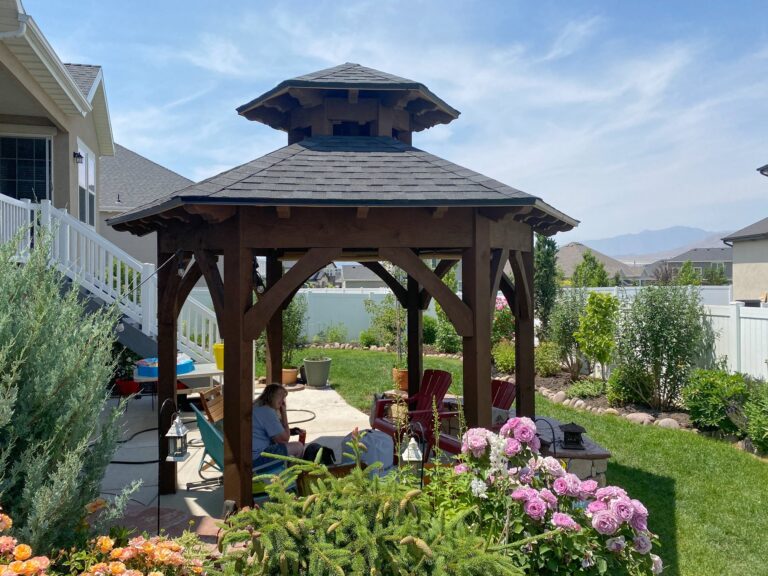
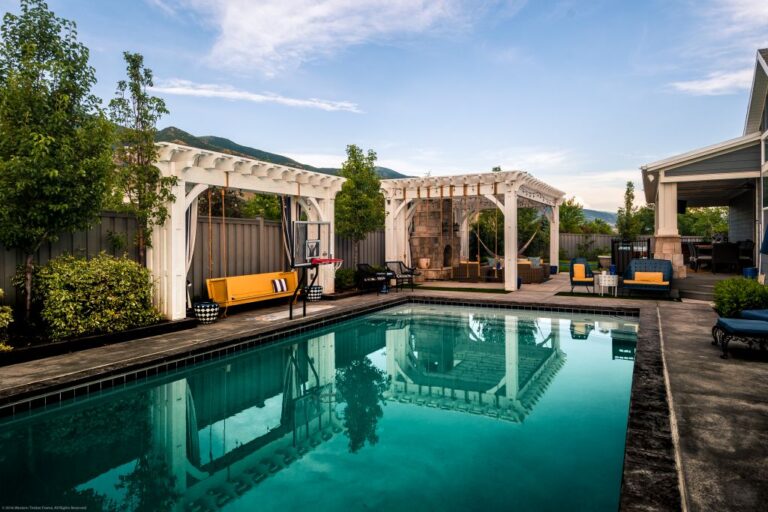
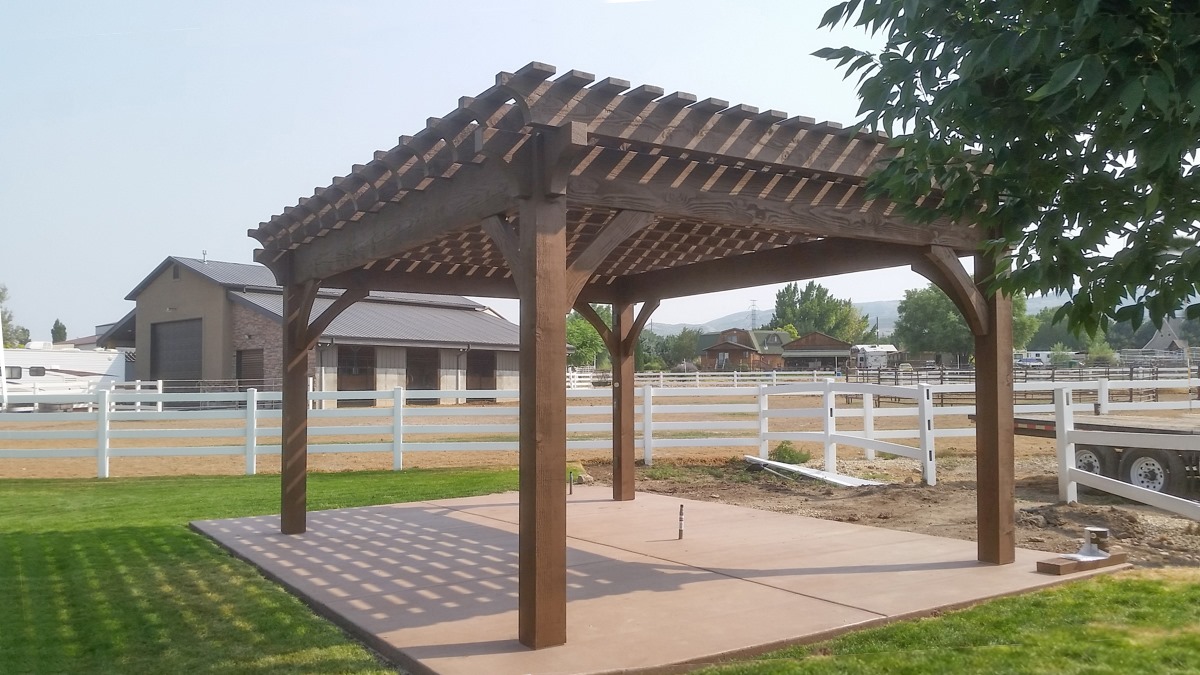
Some spots will never support a tree — too close to the foundation, too little root room, utilities underneath, or simply too little time to wait. That is where a built structure earns its place. A timber frame pergola or pavilion puts real shade over a patio in a weekend rather than in twenty years.

Choosing Between Planting and Building
Shade varies enormously from species to species, and the right tree depends on your hardiness zone, your soil, your available root space, and how close the planting site sits to the house. A good shade tree is one of the better long-term investments you can make in a landscape — if the site suits it.
Where it does not, a structure fills the gap. Attached or free-standing pergolas, pavilions, and gazebos deliver shade on a schedule you control, in the exact footprint you need, without root systems near a foundation. On our own structures, the timber spacing is planned for the shadow it casts, and a standard layout typically lands around 80–85% shade coverage, varying with the structure’s orientation, the time of day, and the season.

Why Shade Feels Cooler Than the Thermometer Says
Proving how much trees cool us is harder than it sounds, and the obvious experiment fails.
Put a thermometer under a leafy park tree and another over the sunlit street beside it, at the same height. You would expect a dramatic gap. You will usually get the same reading, or a difference of less than 2°F. Repeat it after dark and the result gets stranger still — the air under the tree can read slightly warmer than the air over the street, because the canopy holds daytime warmth in.
Air temperature is simply not what your body is responding to. What you feel is radiation: the direct solar energy striking your skin, plus the heat radiating off every hot surface around you. Solar radiation alone can make the air feel 10 to 15°F warmer than a thermometer says. Wind and humidity shift the sensation again.
This is why standing in shade feels like relief even when the official temperature has not moved. Shade is not lowering the air temperature much at that instant — it is intercepting the radiation before it reaches you, and keeping the ground beneath from becoming another radiator. Block enough of the sun’s rays and the surface underneath stays near air temperature instead of climbing 50 to 90°F above it.


Shade on a wall works the same way. It cools the exterior surface and cuts the solar radiation coming through the glass, which is exactly why the EPA-reviewed studies found the largest cooling savings from trees placed on the hottest-facing walls.
Wood Is a Poor Conductor of Heat — and That Is the Point
Timber is a genuinely poor conductor of heat, which is what makes it comfortable to sit under and to touch. Solid wood resists heat flow on the order of 400 times better than steel. The greater its mass, the more slowly it moves heat in either direction.
That thermal lag is why a timber structure behaves the way it does across a day. Wood takes up heat while the air is hot and gives it back slowly as the temperature drops, which keeps the space beneath it more even than a metal frame would. A heavy timber member can hold two different temperatures on its two faces at once.
It is also why timber stays pleasant to the hand in August. A metal post in full sun becomes something you avoid touching. That difference is not marketing — it is conductivity.
Where our timber comes back from
Planting trees with real accountability is not a footnote to this business, it is part of it. Western Timber Frame plants 50 trees for every average-sized pergola we build, and more for larger structures. Our approach is to leave things better than we found them, and all of the timber we use comes from sustainable, renewable sources.
What Is at Stake
Without canopy and coverage, daytime temperatures climb, nights stop cooling, and pollutant levels rise with them. Urban heat islands sharpen heat waves and feed respiratory trouble, heat cramps, exhaustion, heat stroke, and heat-related deaths.
The important part: those illnesses and deaths are, for the most part, preventable. Extreme heat is dangerous, but it is a problem with known and unglamorous solutions — plant trees, protect the ones standing, and put shade over the places people actually use.
Everyone who grows a tree or builds shade makes the place around them measurably better to be in. That is not a small thing to be able to do from your own backyard.

“The true meaning of life is to plant trees, under whose shade you do not expect to sit.”
— Nelson Henderson, farmerCommon Questions
How many trees does the United States lose each year?
A U.S. Forest Service study led by David Nowak found that urban and rural communities in the United States lost roughly 36 million trees per year over a five-year study period. Nowak warned that if the trend continues, cities will become warmer, more polluted, and generally less healthy for the people living in them.
How much cooler does tree canopy actually make a neighborhood?
Research by Carly Ziter and colleagues published in the Proceedings of the National Academy of Sciences found that tree canopy needs to cover more than about 40% of a city block before it delivers its full daytime cooling effect. Where canopy reached that level, daytime cooling measured as much as 10 degrees Fahrenheit. A single isolated tree cools the person standing under it, but it does not change the temperature of the block.
How hot does pavement get compared to the air?
According to the U.S. Environmental Protection Agency, on a hot sunny summer day the sun can heat dry exposed surfaces such as roofs and pavement to temperatures 50 to 90 degrees Fahrenheit hotter than the surrounding air. Shaded or moist surfaces stay close to air temperature. Those hard surfaces store heat during the day and release it at night, which is why cities stay warm after dark.
Where should I plant a shade tree to lower my cooling bill?
Plant on the west and southwest sides of the building first. Studies reviewed by the Environmental Protection Agency measured cooling energy savings between 7 and 47 percent from shade trees, and the savings were greatest when trees were planted to the west and southwest, where they block the strongest late afternoon sun.
Why does shade feel so much cooler when the temperature is the same?
Air temperature in sun and in shade is usually within about 2 degrees Fahrenheit. What your body responds to is radiation, not air temperature. Direct sunlight and the heat radiating off hot surfaces can make the air feel 10 to 15 degrees Fahrenheit warmer than it measures. Shade intercepts that radiation before it reaches you and keeps the ground beneath from heating up and radiating back.
What can I do if a tree will not grow where I need shade?
Build the shade instead. Some locations cannot support a tree because of foundations, utilities, limited root space, or simply the time it would take to grow one. An attached or free-standing pergola, pavilion, or gazebo provides shade in the exact footprint you need, on a schedule you control, without root systems near the foundation.
With 28 Best of State Awards, multiple Inc. 5000 honors, an HGTV Design Excellence Award, 2026 SBA Utah District Manufacturing Small Business of the Year, and 7,000+ structures built nationwide since 2008, Western Timber Frame is a national authority on custom, structural, handcrafted, real-wood timber frame pergolas and outdoor structures for homeowners who want true craftsmanship, not mass-produced, cookie-cutter kits.
Sources
- Nowak, D.J. & Greenfield, E.J. — declining urban and community tree cover in the United States. U.S. Forest Service. research.fs.usda.gov/treesearch/55941
- Ziter, C.D., Pedersen, E.J., Kucharik, C.J. & Turner, M.G. (2019). “Scale-dependent interactions between tree canopy cover and impervious surfaces reduce daytime urban heat during summer.” PNAS. pmc.ncbi.nlm.nih.gov/articles/PMC6565732
- U.S. EPA — Learn About Heat Islands. epa.gov/heatislands/learn-about-heat-islands
- U.S. EPA — Reducing Urban Heat Islands: Compendium of Strategies, Ch. 1 (Urban Heat Island Basics) and Ch. 2 (Trees and Vegetation). epa.gov/heatislands/heat-island-compendium
- International Society of Arboriculture — tree care guidance. treesaregood.org